
Vancouver Previous Residents by Era
No single source lists every person tied to a Vancouver address. Start with the source closest to the period, then use a second record to test the result. Deeds follow recorded interests. Directories and census schedules can show occupants at a point in time. Maps, permits, newspapers, and probate files help explain changes or close gaps.
| Source | Years or local anchor | Where held | What it shows |
|---|---|---|---|
| Auditor deed index | Online 1961 to present; earlier office or archive route | LandmarkWeb, Auditor, Archives, FamilySearch | Recorded parties, instrument date, legal description |
| Clerk and probate files | Several film series from 1890; probate digital from 1997 | Clerk OnBase, film, archive | Public estate, heir, case, and address clues |
| Vancouver directories | 1890 sample; cited issues from 1904; partial holdings into the late twentieth century | CCHM, CCGS, FVRL, WSL | Dated names, occupations, lodging or address text |
| Sanborn maps | 1892 online; later cited maps and State Library film | LOC, WSL, FVRL, CCHM | Block, street, building footprint and use |
| Federal census | Public releases follow the 72-year rule | Library databases and National Archives routes | Household snapshot, relationships and place clues |
| Permits and notices | Coverage depends on system and publication | City or county development office, FVRL, CCHM | Building change, dated notice, probate or family lead |
Recent work usually starts with the current parcel and deed chain. Older work may start in a directory or map, especially when a street number changed or was never printed. Capture the issue, page, map sheet, record ID, and access date. “Previous” does not itself mean that a person moved or died; it only means the evidence belongs to an earlier date.
Trace Past Vancouver Owners Backward
The Clark County Property Information Center gives the starting parcel ID, situs address, tax account, current public ownership field, and legal description. Follow Auditor Docs or open LandmarkWeb. The purchase deed names the seller, who becomes the next person to search as an earlier buyer. Match the legal description at every turn.
- Save the current parcel ID, situs address, legal description, jurisdiction, and linked instrument.
- Open the current purchase deed and identify its grantee, grantor, date, and description.
- Search the seller as a prior grantee, then compare the resulting parcel description.
- Repeat the grantor-to-prior-grantee move until the public web index ends.
- For pre-1961 deeds, contact the Auditor or search archive, film, FamilySearch, and library holdings.
The Auditor accepts office, mail, phone, and email inquiries. Recording and Marriage License is at 1300 Franklin Street, second floor, Vancouver, with phone 564-397-2208 and recording@clark.wa.gov. Online document images are convenience copies; certified copies come through the office. A no-result page may mark a date cutoff or index problem rather than the end of the chain.
- Grantor and grantee
- The grantor gives a recorded interest; the grantee receives it.
- Chain of title
- The sequence of recorded interests in land, which is not a list of all occupants.
- Legal description
- Lot, block, tract, subdivision, or boundary language that can stay useful when a street address changes.
- Situs address
- The location address assigned through the responsible jurisdiction's planning and addressing process.
Vancouver Deed Dates Have a Cutoff
The 1961 start of the public LandmarkWeb index is one of the most important limits in a previous-residents search. It is an online boundary, not the year land records began. Earlier instruments may remain in deed books, microfilm, transferred county records, or archive images. Search by party, parcel, instrument, book and page, legal description, record date, and excise number when those fields are known.
The Clark County recorded-document interface shows how the index connects search fields to an instrument.
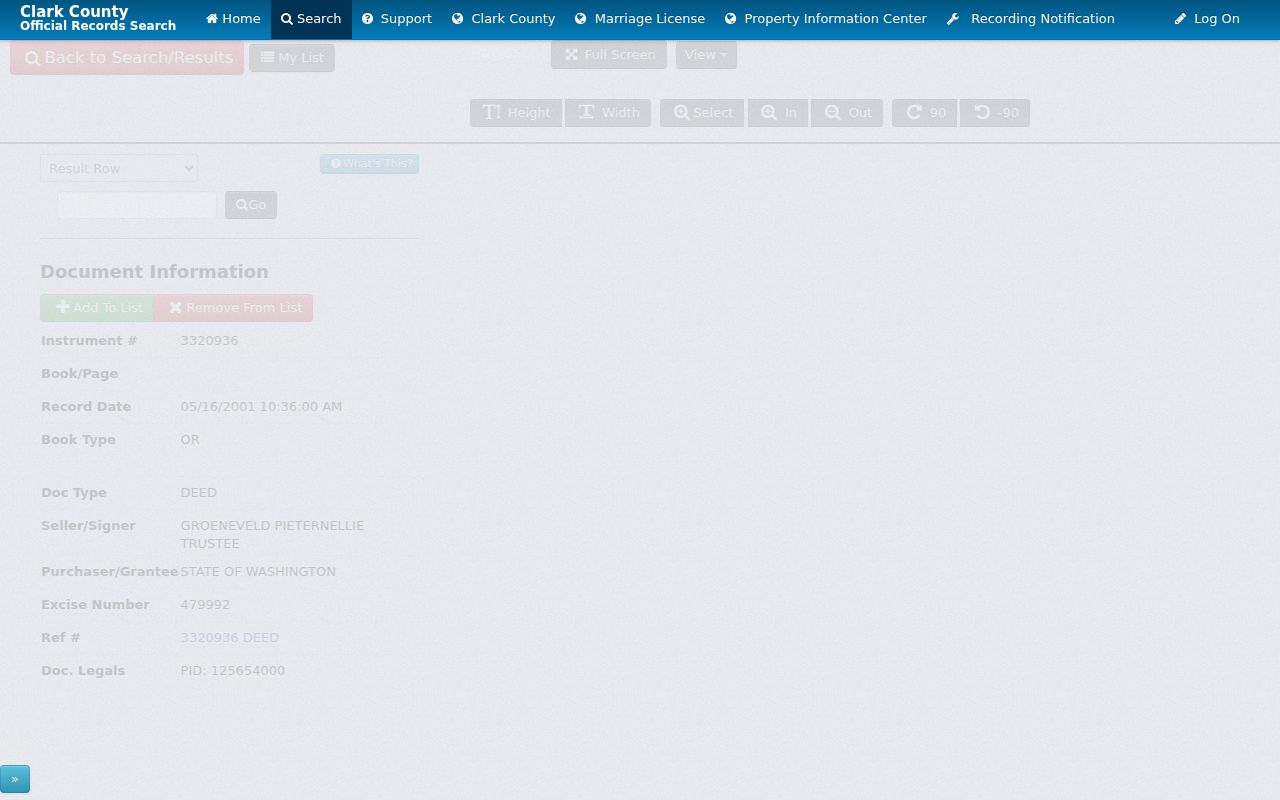
The image represents the deed-index step. Its record parties can identify past owners, but do not by themselves establish who slept, received mail, or formed a household at the property.
Note: Save both the deed recording date and the assessor update date because county ownership fields may lag a recorded transfer by weeks.
Pair Vancouver Directories With Census
Owners tell only part of a house story. A city directory issue can associate a person with a residence, room, boarding place, office, or business. A federal census schedule gives a different household snapshot. Search the directory year before the target date, the target issue, and the next available issue. Then compare a public census year under the federal 72-year release rule.
- Copy the directory headword, initials, occupation, employer text, lodging mark, and full address exactly.
- Search the same surname on nearby streets and under alternate initials or spellings.
- Place the address on a period map and note its block, intersection, or subdivision.
- Compare a released census schedule, allowing for a different date and household definition.
- Test the names against deeds, probate, obituaries, yearbooks, or newspapers without merging distinct people.
The full publisher and shelf history belongs to the Vancouver city directory collections. For a backward address trail, the key is the dated entry. FVRL offers licensed Ancestry Library in its buildings, HeritageQuest, FIMO, Newspapers.com, ProQuest, and Access World News. CCHM and CCGS add local print, map, newspaper, cemetery, and genealogy material.
Old Vancouver Entries Need Translation
The 1890 Vancouver sample is not formatted like a modern address list. It uses short text such as res, bds, rms, cor, nr, and bet. Entries can name an intersection instead of a number and may include an occupation, employer, or business. Preserve those strings before interpreting them, since the inspected sample did not supply a full abbreviation key.
Historical labels also matter. Clark County appeared as “Clarke” until 1925, and older sources may use “Vancouver District.” Search both spellings, directional street forms, nearby intersections, plat names, and subdivision terms. No official source confirmed one citywide renumbering date. Bridge a questionable address through the directory, deed description, plat, period map, current parcel, and annexation record.
The same “Vancouver” label can cross postal, municipal, county, and Census geography. Confirm the current city status with the City boundary checker and the historical status through a dated map or annexation source. This prevents two similar address strings from being treated as the same property without proof.
Map Previous Vancouver Addresses
The 1892 Vancouver Sanborn fire-insurance set has nine sheets available from the Library of Congress. It can show streets, blocks, building footprints, uses, and the built setting around an old directory entry. Later Vancouver maps are cited for 1907, 1908, 1911, and 1929, while Washington State Library microfilm extends into the 1950s. Check the exact sheet and edition.
A map is not a person index. Its strength is physical continuity. It can help decide whether an address refers to the same block, whether a building existed in the target year, and how a lot related to an intersection. Pair it with a plat and legal description before joining it to a modern parcel. If the building changed, permits may date construction, alteration, or demolition, though the complete historical permit start was not established.
Vancouver's buried streetcar tracks offer useful local context. Horse railway service ran from 1889 to 1895, electric service from 1908 to 1926, and tracks were paved over in 1926. A period map can therefore preserve part of a street's use that no longer appears above ground.
Vancouver Repositories Fill Missing Years
House-history support is spread across several repositories. The Clark County Historical Museum Research Library at 1511 Main Street lists Polk directories, historic-home surveys, maps, newspapers, oral histories, cemetery files, and topical boxes. Its staff research policy is useful when an on-site visit is not practical.
The Clark County Genealogical Society library at 3205 NE 52nd Street holds more than 8,000 regional items and has a cataloged 1959 Vancouver directory. The Fort Vancouver Regional Libraries genealogy resources provide licensed databases and newspaper tools. Washington State Library has non-circulating directory and microfilm holdings. FamilySearch and Washington Digital Archives can cover transferred county images, but their dates and indexing vary by collection.
The CCHM Research Library page shows the local-history access point for house and resident research.
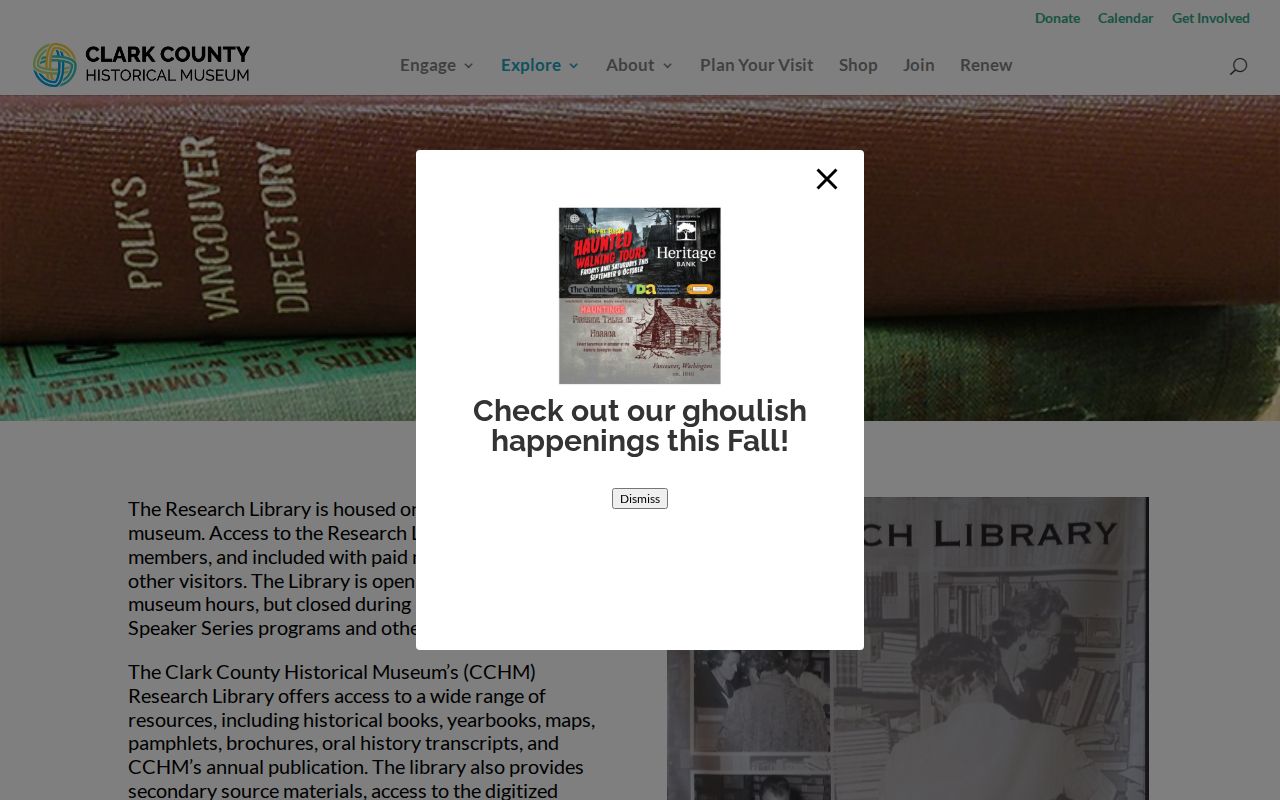
The repository view represents the offline fallback that becomes essential when a directory issue, historic-home survey, map, or local newspaper is not freely searchable online.
Ask each repository about the exact issue, map edition, street index, house-history file, or newspaper date needed. No verified complete local reverse-directory run was found, and the last printed Vancouver directory year was not confirmed by an official catalog. State those gaps instead of turning partial bibliography dates into a complete shelf claim.
Close Vancouver Resident Trails Carefully
Obituaries, probate files, cemetery records, and newspapers can connect a former address to relatives, an estate, or a later place. FVRL's Access World News coverage for The Columbian runs from May 26, 1994 through April 29, 2024, while its ProQuest run is January 1, 1995 through February 3, 2024. These are database coverage dates, not the full life of the newspaper.
Clark County probate film begins in 1890 and runs through 1985; digital probate coverage begins in 1997. The Clark County Clerk provides OnBase lobby terminals, email and phone contact, and archive research channels. Public status varies by filing. A newspaper notice is a lead, while a filed probate document can give a case-based clue. Neither should be stretched past what it states.
Vital records have separate date and relationship rules. Clark County Public Health and the Washington Department of Health distinguish certified from informational copies, with local and state coverage varying by type. Use those channels when eligible, but do not treat a restricted certificate as a gap that can be filled by guesswork.
Limits on Vancouver Previous Residents
Past residents are not the same as past owners. A chain of title follows recorded land interests. A directory is a publication snapshot. A census has its own enumeration date and household rules. A mailing address may belong to an owner, estate, or organization away from the site. A permit applicant may never have lived there. Keep each label and date intact.
Apartment buildings and shared parcels create added uncertainty. One parcel cannot enumerate each unit. An absent directory entry may result from spelling, timing, publication policy, an unindexed page, or the wrong jurisdiction. A historical map can prove that a building stood on a block, but not who was inside it.
Lawful use. Trace Vancouver previous residents for house history, genealogy, heir research, or personal curiosity. Never use the findings to track, stalk, harass, intimidate, or harm a living person.
Finish with a short evidence log: source title, exact year, page or sheet, parcel or instrument number, address as printed, name as printed, and the next record that supports the match. That record makes “who lived here before” a reproducible conclusion rather than a chain of similar names.